by Ettore Vellutini
Introduction: a face for power
Before Julius Caesar, the face of a living man did not appear on Roman coins. The magistrates who issued them celebrated ancestors, gods and the glories of their own family, but not themselves. Caesar changed the rules: he understood that power, to endure, needed a recognisable face, and that this image had to be built with the same care as a military campaign.
His iconography thus arose from an interweaving of elements: the victorious general, the descendant of Venus, the pontifex maximus, the dictator. After his death, the most powerful of all was added: the god.
Coins: a portrait in every citizen’s pocket
During the civil war, between 49 and 48 BC, Caesar had a denarius struck that was destined to become famous: on one side an elephant trampling a serpent, with the inscription CAESAR beneath; on the other, the instruments of the pontifical cult. The elephant evoked strength and victory, but also, according to an ancient tradition, a play on Caesar’s own name. The sacred instruments recalled his office of pontifex maximus. Without yet showing his face, the coin already presented him as both military and religious leader.
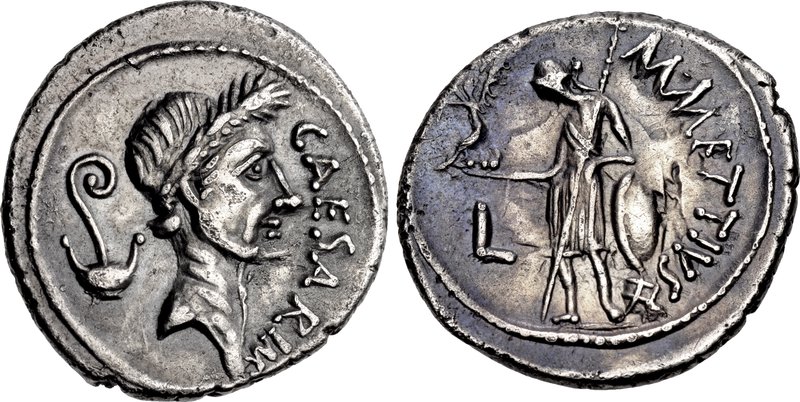
The real turning point came at the beginning of 44 BC. For the first time in Roman history, the portrait of a living man appeared on denarii: Caesar’s thin, lined face, wreathed in laurel, accompanied by legends such as CAESAR DICT PERPETVO, “Caesar, dictator for life”. Other issues show him with his head veiled, in the gesture of a priest offering sacrifice. Coins passed from hand to hand, reaching soldiers in the provinces and merchants in the ports: they were the most far-reaching means of communication in the ancient world.
The triumphator’s laurel
The laurel wreath was the sign of the triumphant general, who wore it only on the day of his triumph. The Senate granted Caesar the right to wear it always. Suetonius, with a touch of irony, relates that of all the honours he received none pleased him more, because it allowed him to hide the baldness that troubled him so much.
Behind the anecdote lies a precise choice: the laurel turned every public appearance of Caesar into a reminder of his victories. In 46 BC he celebrated four triumphs, over Gaul, Egypt, Pontus and Africa. In the Pontic triumph, according to Suetonius, a placard was carried bearing just three words: Veni, vidi, vici. Even writing was image: concise, military, impossible to forget.
Veni, vidi, vici.
Inscription carried in the Pontic triumph, 46 BC
Son of Venus
The gens Iulia traced its origins to Iulus, son of Aeneas, and therefore to Venus, mother of the Trojan hero. Caesar turned this genealogy into a political programme. In the new Forum that bears his name he built the temple of Venus Genetrix, dedicated in 46 BC: the goddess was not only the protector of Rome but the direct ancestor of the dictator.
The message was clear: Caesar’s power came not only from the legions or the elections, but from divine blood. It was an idea that Augustus would take up and bring to completion, making descent from Venus one of the pillars of imperial ideology, celebrated also in Virgil’s Aeneid.
Statues and honours: from man to demigod
In the last months of his life the honours decreed to Caesar multiplied. The sources mention a statue of him placed on the Capitol beside those of the ancient kings of Rome, and another in the temple of Quirinus, the god into whom Romulus was believed to have been transformed, with an inscription celebrating him as an unconquered god. He was allowed to sit on a golden chair and to wear triumphal dress on public occasions.
For many senators it was too much. The image of Caesar, ever closer to that of a king or a god, fuelled the fear that the Republic was finished. On 15 March 44 BC the conspirators killed him during a session of the Senate.
The faces of Caesar we know
What Caesar really looked like is a question that has fascinated people for centuries. The portrait found at Tusculum, now in Turin, is considered by many scholars one of the few, if not the only one, made while he was still alive: a lean face, a long neck, a high forehead, far from any idealisation. Most of the portraits that have come down to us are instead posthumous, such as the so-called “Green Caesar” in Berlin, carved in dark Egyptian stone, or the busts of the imperial era that soften his features.
In Rome, along Via dei Fori Imperiali, the bronze statue depicting him in military dress is a modern copy of an ancient statue kept on the Capitol. It is perhaps the most photographed image of Caesar in the world, and confirms how closely his figure has remained tied to that of the military commander.
After the Ides: the star and the god
Death did not extinguish Caesar’s iconography: it made it more powerful. In July 44 BC, during the games organised in his honour by the young Octavian, a comet shone for several days in the sky over Rome. The people interpreted it as Caesar’s soul being received among the gods: thus was born the sidus Iulium, the Julian star.
Octavian made it a symbol. A star was added to the head of Caesar’s statues and appeared on coins, with the legend DIVVS IVLIVS. In 42 BC Caesar was officially deified, and in 29 BC the temple of the Divine Julius was dedicated in the Forum, on the spot where his body had been cremated. Octavian, his adopted son, could now present himself as Divi filius, “son of the god”.
The assassins’ reply
His opponents, too, understood the value of images. Between 43 and 42 BC Brutus had one of the most famous denarii in history struck: on the reverse a Phrygian cap, the pileus given to freed slaves, between two daggers, and the inscription EID MAR, the Ides of March. The message was the reverse of Caesar’s: not a face to be venerated, but a deed to be claimed as liberation.
A two-thousand-year legacy
Caesar’s iconography far outlived his era. His name became a title, from which “Kaiser” and “tsar” derive. In the Renaissance Andrea Mantegna dedicated a grand cycle of canvases to his triumphs, now at Hampton Court, while generations of sovereigns and generals had themselves portrayed with laurel and cuirass, imitating his pose.
Caesar was among the first to understand that the battle for power is also fought on the terrain of images: a coin, a statue, a laurel wreath, a star in the sky. A lesson that, in different forms, Napoleon would take up eighteen centuries later, as I recount in the article The Eagle and the Brush.
Featured image: Silver denarius of Julius Caesar, January–February 44 BC, Rome mint, moneyer M. Mettius. Photo: Classical Numismatic Group (CNG), licence CC BY-SA 2.5, via Wikimedia Commons.