Introduction: the image as a weapon
No commander before Napoleon Bonaparte understood so clearly that a campaign is won twice: on the battlefield and in the imagination of those who hear about it. Between 1796 and 1815 the young general of the Army of Italy, then First Consul, then Emperor of the French, built around himself a system of images as coherent as an order of battle.
Painters and sculptors such as Jacques-Louis David, Antoine-Jean Gros, Jean-Auguste-Dominique Ingres and Antoine-Denis Chaudet did not merely portray him. They translated a precise political programme into visual form: legitimising a power born of the Revolution and of military victory by linking it to Rome, to Charlemagne and to the sacred aura of kings.
In this article we retrace the key works of that season, the symbolic vocabulary they share and the way in which, after Waterloo, the image of the Emperor was transformed into legend.
The heroic general: Bonaparte at the Bridge of Arcole
The first great Napoleonic image was born in Italy. In November 1796, during the Battle of Arcole (15–17 November), Bonaparte seized the tricolour and rushed onto the bridge over the Alpone to lead his grenadiers into the assault. The episode, in reality less decisive than was claimed, immediately became material for propaganda.
Antoine-Jean Gros, a pupil of David, portrayed him in Milan between 1796 and 1797. The canvas, Bonaparte au pont d’Arcole (versions at Versailles and the Louvre), shows a twenty-seven-year-old with long hair, the flag gripped in his left hand, his sword in his right, his gaze turned back towards his soldiers. According to tradition, it was Joséphine who held him on her lap so that he would pose for a few minutes.
The painting establishes the first archetype: the soldier-general who risks his life in the front line. There is nothing imperial about it yet, only daring, youth and the flag of the Republic.
The commander on the Alps: David and the Great St Bernard
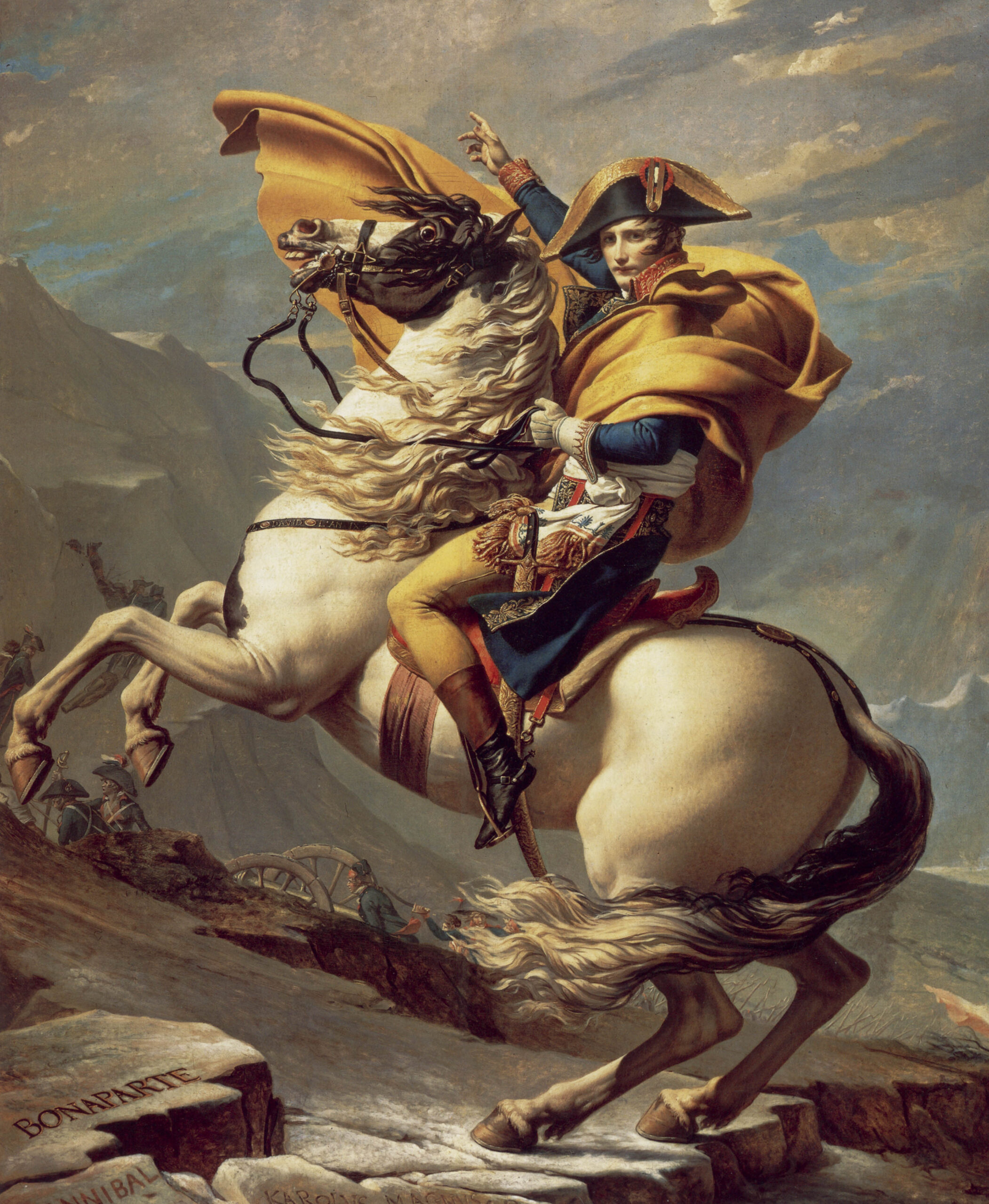
In May 1800 the First Consul crossed the Great St Bernard Pass with the Army of the Reserve, on the eve of Marengo. He did so, prosaically, on the back of a mule led by a mountain guide. Jacques-Louis David would make something quite different of it: Bonaparte franchissant le Grand-Saint-Bernard (1801–1805), originally commissioned by King Charles IV of Spain.
Napoleon refused to sit for it and asked to be shown “calm on a fiery horse”. The result is an icon built with rigour: the rearing steed, the cloak billowing in the wind, the arm pointing to the summit. Carved on the rocks in the foreground are three names: Bonaparte, Hannibal and Charlemagne (KAROLUS MAGNUS). It is an explicit genealogy of the great men who crossed the Alps.
Five autograph versions of the work exist, today at Malmaison, Charlottenburg (Berlin), the Belvedere in Vienna and two at Versailles. The variations in the colour of the cloak and the horse confirm that this was a serial image, designed to circulate among the courts of Europe.
The healer of Jaffa: Gros and the plague-stricken
The Egyptian and Syrian campaign was, militarily, a failure. For this reason it needed a narrative more than others did. On 11 March 1799 Bonaparte visited the plague hospital set up in a mosque in Jaffa. At the same time rumours were circulating about the poisoning of the sick during the retreat and the execution of Turkish prisoners.
Gros responded with Les Pestiférés de Jaffa, exhibited at the Salon of 1804 and now in the Louvre. The general, surrounded by officers covering their faces, touches a soldier’s bubo with his bare hand. The gesture deliberately recalls the “royal touch” with which the kings of France healed sufferers of scrofula.
The message is twofold: the leader who does not fear contagion and shares the fate of his troops, and the future sovereign endowed with an almost sacred power. The painting was exhibited a few months before the coronation, and not by chance.
The consecration: David’s Sacre and Ingres’s throne
On 2 December 1804, in Notre-Dame, in the presence of Pope Pius VII, Napoleon placed the golden laurel crown on his own head and then crowned Joséphine. David, appointed First Painter to the Emperor, devoted his most imposing painting to that ceremony: Le Sacre de Napoléon (1805–1807, Louvre), a canvas more than six metres high and almost ten wide.
The choice of moment is political. The initial sketch showed Napoleon crowning himself, a gesture too aggressive towards the Pope. David fell back on the crowning of Joséphine, more chivalrous. He also placed in the gallery Letizia Ramolino, Napoleon’s mother, who in reality did not attend the ceremony: the family had to appear united.
In 1806 the young Ingres exhibited at the Salon Napoléon Ier sur le trône impérial (Musée de l’Armée, Paris). It is a hieratic, frontal, almost Byzantine image: the sceptre, the ivory hand of justice, the sword known as Charlemagne’s, the velvet mantle strewn with golden bees, the imperial eagle in the carpet. Its visual sources are Phidias’ Zeus and God the Father from van Eyck’s Ghent Altarpiece. Critics judged it “Gothic” and panned it; today it is perhaps the portrait that best expresses the claimed sacredness of Napoleonic power.
Eylau: the victor’s compassion
On 8 February 1807, at Eylau in East Prussia, the Grande Armée and the Russian army clashed in the snow in one of the bloodiest battles of the era, with no clear winner. The next day Napoleon rode across the field covered with the fallen.
To manage the impact of that massacre, Vivant Denon, director of the Musée Napoléon, launched a competition among painters. Gros won it with Napoléon sur le champ de bataille d’Eylau (1808, Louvre). The Emperor, on horseback, raises his eyes to the sky in a gesture of compassion; a wounded Lithuanian chasseur thanks him, while in the foreground lie bodies stiffened by the frost, rendered with raw realism.
It was a turning point. The painting does not celebrate the assault but the cost of war, and attributes to the sovereign the virtue of clemency. For a military audience it is perhaps the most honest work of the cycle: victory appears for what it often is, a field of the dead in the snow.
Sculpture: marble, bronze and the stone of Paris
If painting narrates, monumental sculpture fixes power in urban space. The model is openly imperial Rome.
The Vendôme Column (1806–1810) takes up Trajan’s Column. The shaft is clad in a spiral of bronze bas-reliefs narrating the campaign of 1805, cast from the metal of cannon captured at Austerlitz. At the top Antoine-Denis Chaudet placed Napoleon dressed as Caesar. The statue was melted down after 1814; in 1833 Louis-Philippe installed Charles-Émile Seurre’s “Petit Caporal” in redingote and bicorne. The column was toppled by the Commune in 1871 and re-erected a few years later.
The Arc du Carrousel (1806–1808), the work of the architects Percier and Fontaine in front of the Tuileries, celebrates the victories of 1805. It was crowned by the four bronze horses of St Mark’s, taken from Venice in 1797 and returned in 1815. The Arc de Triomphe de l’Étoile, commissioned in 1806, would only be completed in 1836.
A case apart is Antonio Canova, summoned to Paris in 1802. His Napoleon as Mars the Peacemaker, a colossal heroic nude in marble, did not please its subject, who found it too athletic. It remained hidden in the Louvre and in 1816 was bought by the British government and given by the Prince Regent to the Duke of Wellington: it is still at Apsley House in London today. A bronze copy dominates the courtyard of the Brera in Milan. The episode reveals a precise limit of Napoleonic iconography: heroism in the antique manner, yes, but without giving up the uniform and recognisability.
The symbolic vocabulary of the Empire
Behind the individual works lies a heraldic lexicon carefully chosen in 1804, which every artist was required to respect.
- The eagle. A direct legacy of the Roman legions. On 5 December 1804, on the Champ de Mars, Napoleon presented the regiments with the new gilded bronze eagles, which the soldiers swore to defend to the death. David immortalised the scene in La Distribution des aigles (1810, Versailles).
- The bees. They replaced the Bourbon lilies. They refer to the small golden bees (in reality probably cicadas) found in 1653 at Tournai in the tomb of Childeric I, father of Clovis: a reference to the most ancient Frankish monarchy, earlier than the Capetians.
- The crowned N within a laurel wreath. The imperial monogram, present on uniforms, furnishings, porcelain and architecture.
- The laurel. The crown of the Roman triumphator, chosen for the Sacre instead of the closed crown of kings.
- The Carolingian regalia. Sword, sceptre and hand of justice evoke Charlemagne, Emperor of the West: Napoleon presented himself as his successor rather than as heir to the Bourbons.
For those familiar with medieval symbolism, this is the most interesting point. A regime born of the Revolution rebuilt a monarchical sacredness within a few months, drawing on Rome and the Franks.
After the fall: from propaganda to legend
With Waterloo and exile on Saint Helena, the iconography changed in nature. It no longer served to legitimise power, but to cultivate a myth. The tone became melancholic, the protagonist became the man rather than the sovereign, and beside him appeared the “grognard”, the veteran of the Guard, popularised by the lithographs of Charlet and Raffet.
Paul Delaroche painted Napoléon à Fontainebleau, 31 mars 1814 (1840, Musée de l’Armée; a larger 1845 version is in Leipzig): the Emperor seated, mud-spattered, alone, on the eve of his abdication. A few years later he dismantled David’s icon with Bonaparte franchissant les Alpes (1848–1850), in which the commander, numb with cold, climbs on a mule led by a peasant. Ernest Meissonier, with 1814, Campagne de France (1864, Musée d’Orsay), shows the General Staff advancing grimly through muddy snow: military genius at its twilight.
Sculpture followed the same path. At Fixin, in Burgundy, François Rude created between 1845 and 1847 Napoléon s’éveillant à l’immortalité, commissioned by Claude Noisot, a former grenadier captain who had followed the Emperor to Elba. A monument raised out of loyalty by an old soldier: a detail worth remembering.
The journey ends at Les Invalides. After the “Retour des cendres” of 15 December 1840, Louis Visconti designed the tomb: a sarcophagus of red stone at the centre of a circular crypt, watched over by twelve Victories by James Pradier. The image of Napoleon definitively became national memory.
Conclusion
In less than twenty years the image of Napoleon passed from the general with the flag at Arcole to Ingres’s emperor-icon, and on to the defeated veteran of Delaroche and Meissonier. Each phase met a precise need: to win consensus, to found a dynasty, to preserve a memory.
For those who wear a uniform these works hold a particular value. They show how command is also representation, and how art can exalt the glory of arms or, as at Eylau, remind us of its price.
Where to see the works mentioned
| Work | Artist | Year | Location |
| Bonaparte au pont d’Arcole | Gros | 1796-1797 | Versailles; Louvre, Paris |
| Bonaparte franchissant le Grand-Saint-Bernard | David | 1801-1805 | Malmaison; Versailles; Charlottenburg, Berlin; Belvedere, Vienna |
| Les Pestiférés de Jaffa | Gros | 1804 | Louvre, Paris |
| Le Sacre de Napoléon | David | 1805-1807 | Louvre, Paris |
| Napoléon Ier sur le trône impérial | Ingres | 1806 | Musée de l’Armée, Paris |
| Napoleon as Mars the Peacemaker | Canova | 1802-1806 | Apsley House, London; bronze copy at the Brera, Milan |
| Napoléon sur le champ de bataille d’Eylau | Gros | 1808 | Louvre, Paris |
| Vendôme Column | Gondoin, Lepère, Chaudet | 1806-1810 | Place Vendôme, Paris |
| Arc du Carrousel | Percier and Fontaine | 1806-1808 | Jardin des Tuileries, Paris |
| La Distribution des aigles | David | 1810 | Versailles |
| Napoléon à Fontainebleau, 31 mars 1814 | Delaroche | 1840 | Musée de l’Armée, Paris; 1845 version in Leipzig |
| Napoléon s’éveillant à l’immortalité | Rude | 1845-1847 | Parc Noisot, Fixin |
| 1814, Campagne de France | Meissonier | 1864 | Musée d’Orsay, Paris |
| Napoleon’s Tomb | Visconti, Pradier | 1842-1861 | Hôtel des Invalides, Paris |
Hashtags for sharing
#Napoleon #NapoleonicIconography #MilitaryArt #MilitaryHistory #FirstEmpire #JacquesLouisDavid #Gros #Ingres #Canova #VendomeColumn #Invalides #ArtAndHistory
Sources
- Fondation Napoléon, Les grands tableaux du Ier Empire (Arcole, Jaffa, Sacre, Eylau)
- Fondation Napoléon, Le tableau de Gros : Les Pestiférés de Jaffa
- Fondation Napoléon, Bonaparte franchissant le col du Grand Saint-Bernard
- J. Paul Getty Museum, Bonaparte Crossing the Alps at Grand-Saint-Bernard
- Fondation Napoléon, Napoleon I on his Imperial Throne
- Musée de l’Armée, Educational sheet: Napoléon Ier sur le trône impérial
- Fondation Napoléon, Napoléon visitant le champ de bataille d’Eylau
- Museo Gypsotheca Antonio Canova, Napoleone come Marte pacificatore
- Wikipedia, Napoleon as Mars the Peacemaker
- Fondation Napoléon, Colonne Vendôme and Maquette de la colonne de la Grande Armée
- Fondation Napoléon, Symbolique impériale
- Fondation Napoléon, Napoléon Ier à Fontainebleau le 31 mars 1814
- Fondation Napoléon, Campagne de France, 1814
- Fondation Napoléon, Napoléon s’éveillant à l’immortalité
- Fondation Napoléon, Les Invalides, le tombeau de Napoléon
- Wikipedia, Napoleon’s tomb