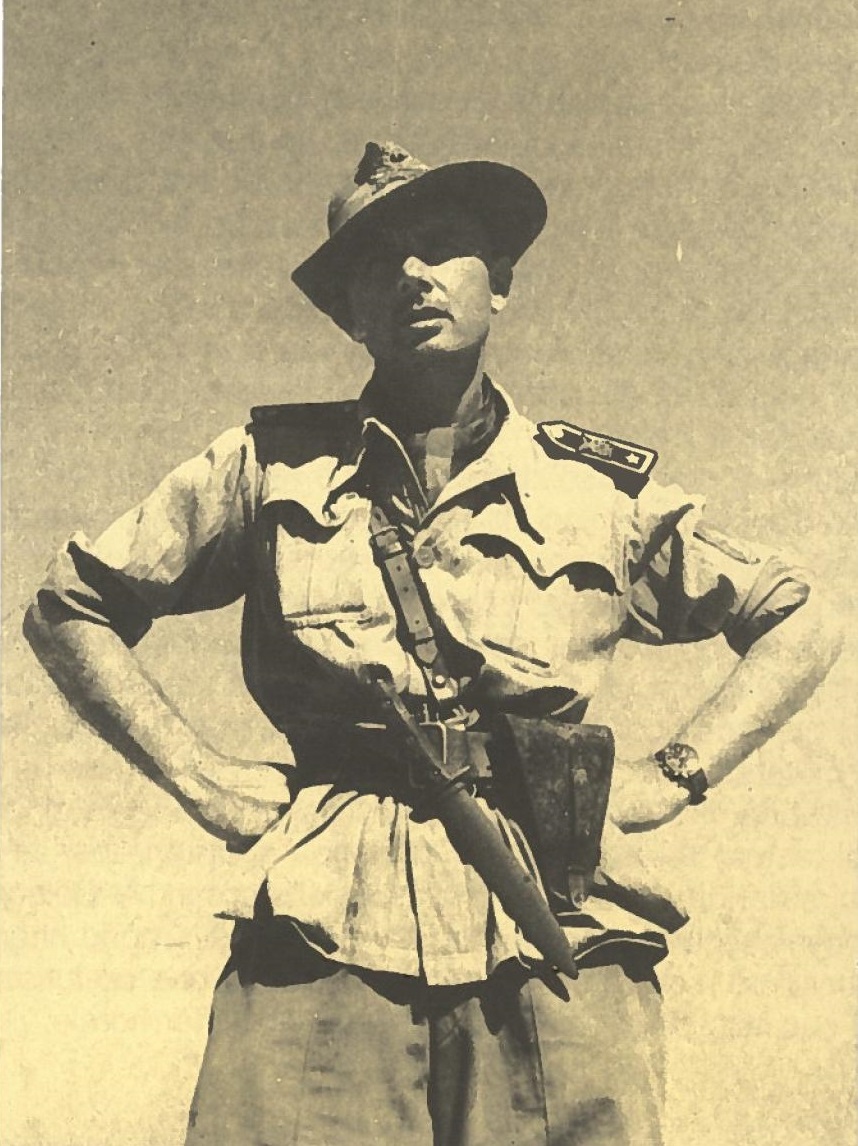
by Ettore Vellutini
Introduction: returning to the battlefield
In 1948 a fifty-two-year-old engineer from Milan went back to the Egyptian desert, to the very ground where six years earlier he had commanded a battalion of assault engineers. He did not go to commemorate: he went to search. Beneath the sand of El Alamein lay thousands of Italian soldiers, buried in haste during the fighting, scattered among the minefields or never found. Paolo Caccia Dominioni devoted fourteen years of his life to them, and in the end he gave them a home: the Italian military memorial of Quota 33, Hill 33.
His story brings together three callings rarely found in the same man: the soldier, the architect and the storyteller. It is precisely this combination that makes the El Alamein memorial something more than a war cemetery.
An engineer with a pencil in his pocket
Paolo Caccia Dominioni was born in Nerviano, near Milan, on 14 May 1896, into a family of the Lombard nobility. His father Carlo was a diplomat, and young Paolo grew up following him between France, Austria-Hungary, Tunisia and Egypt. When Italy entered the war in May 1915, he broke off his engineering studies and volunteered. On the Isonzo and Karst front he commanded a flamethrower section, was wounded twice and received the Bronze Medal of Military Valour.
After graduating from the Politecnico di Milano in 1922, he chose Egypt. From 1924 he worked mainly in Cairo as an engineer and architect, while writing for the Corriere della Sera, for which he was a correspondent from 1931 to 1961. In those years he met and befriended Vladimir Peniakoff, the future “Popski” of the British commandos: the two friends would find themselves on opposite sides in the Libyan desert. In the 1930s Caccia Dominioni took part in reconnaissance missions in Libya, Sudan and Ethiopia and fought in the Ethiopian war, earning a War Cross for Military Valour.
He therefore knew everything about the desert: its tracks, its depressions, its people. It was this knowledge that later made him the right man for a task no one else could have undertaken.
In command of the XXXI Guastatori
In the summer of 1942 he asked to join the assault engineers and took command of the XXXI Battaglione Guastatori d’Africa, which had lost its commander. With his men he fought in the First Battle of El Alamein, at Alam el Halfa and in the Second Battle of El Alamein. For his actions in the summer of 1942, Erwin Rommel personally awarded him the Iron Cross, Second Class.
During the November retreat the XXXI managed to escape the British encirclement, a feat that earned its commander the Silver Medal of Military Valour. Back in Italy, in 1943 he re-formed the unit as an Alpine battalion at Asiago; after 8 September he chose the Resistance, was arrested twice and ended the war as Chief of Staff of the Corpo Volontari della Libertà in Lombardy.
Fourteen years among mines and sand
As early as 1943 the British authorities had prisoners build an Italian-German cemetery on the slopes of Hill 33, but most of the fallen still lay scattered across the desert. In 1948, at the request of the Italian consul Alfredo Nuccio and on behalf of the Commissariat General for the Honours to the War Fallen, Caccia Dominioni agreed to lead the search mission.
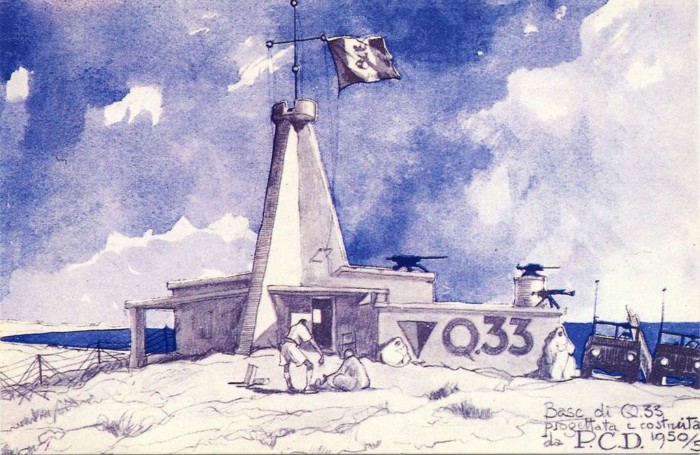
The base camp was set up on Hill 33 itself, the height where on 10 July 1942 the LII Group of 152/37 guns had fought to the last. From there the patrols set out: Caccia Dominioni himself, the sapper Renato Chiodini, who joined him in 1950 and became his inseparable companion, and the Bedouin guides who knew every track. The work was slow and dangerous. The desert was still littered with mines: seven local helpers died during the searches, and Caccia Dominioni’s own vehicle twice ran onto a minefield.
Every body recovered was an investigation: an identity tag, a document, a scrap of uniform, the position of a gun pit compared with the units’ war diaries. According to the Italian Army, the mission carried out 355 patrols covering some 400,000 kilometres and, in addition to the Italian fallen, recovered around 6,000 German and Allied soldiers. Many men who would have remained “unknown” got their names back.
The memorial at Hill 33
While the searches went on, Caccia Dominioni designed the place that would receive the fallen. The memorial stands at kilometre 120 of the coast road from Alexandria to Marsa Matruh, on land granted by Egypt to Italy for ninety-nine years, and was built between the mid-1950s and 1958. Not far away, on a nearby hill, the German fallen were laid to rest in a tower of medieval appearance.
The Italian building is a white octagonal tower, slightly tapering towards the top, which widens at its base into a broad pavilion. Inside, a semicircular gallery opens onto the Mediterranean through five large windows; the altar stands beneath a tall cross running up the inner wall of the tower. It is a sober architecture, free of rhetoric: its shape recalls both a fortress and a lighthouse, facing the sea and Italy.
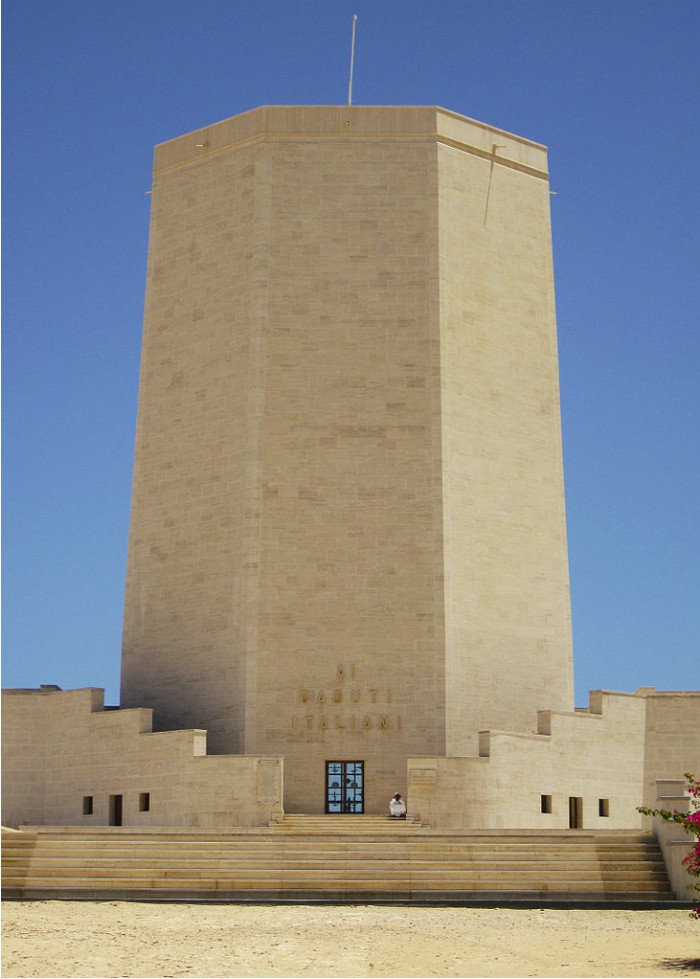
The memorial holds more than 5,200 Italian fallen. Along the coast road, the complex is completed by the entrance portico with its court of honour, a small room of relics and the cemetery of the Libyan Askari, with its mosque and the graves of 232 soldiers who fought under the Italian flag. In 1960 a chapel beneath the portico also received the remains of one hundred Italian workers who died building the Aswan, Edfina and Esna dams.
The pen and the watercolour
Caccia Dominioni told this long story in Alamein 1933-1962, published by Longanesi in 1962 and winner of the Premio Bancarella in 1963. The book spans thirty years: from the desert he came to know as a young engineer, through the battle, to the completion of the memorial. It was published in English in 1966 as Alamein 1933-1962: An Italian Story and remains one of the clearest and most humane accounts of the war in Africa.
Alongside writing there was drawing. Caccia Dominioni left more than a thousand drawings, sketches and watercolours, largely on military subjects, the work of an engineer’s eye trained to observe and to measure. It is this double hand, the one that designs and the one that tells, that makes everything he left behind so recognisable.
Conclusion: a name for each of them
Paolo Caccia Dominioni died in Rome on 12 August 1992, aged ninety-six, at the Celio Military Hospital. Renato Chiodini carried on his work in the desert, on the trail of the fallen they had searched for together.
In 2022, for the eightieth anniversary of the battle, Italy issued a stamp dedicated to the El Alamein memorial. Yet Caccia Dominioni’s truest monument is not the white tower by the sea: it is the patient work behind every headstone. To give a soldier back his name is to give him back to his family and to history. For those who visit Hill 33 today, those names carved one by one bear witness to a man who refused to leave anyone behind.