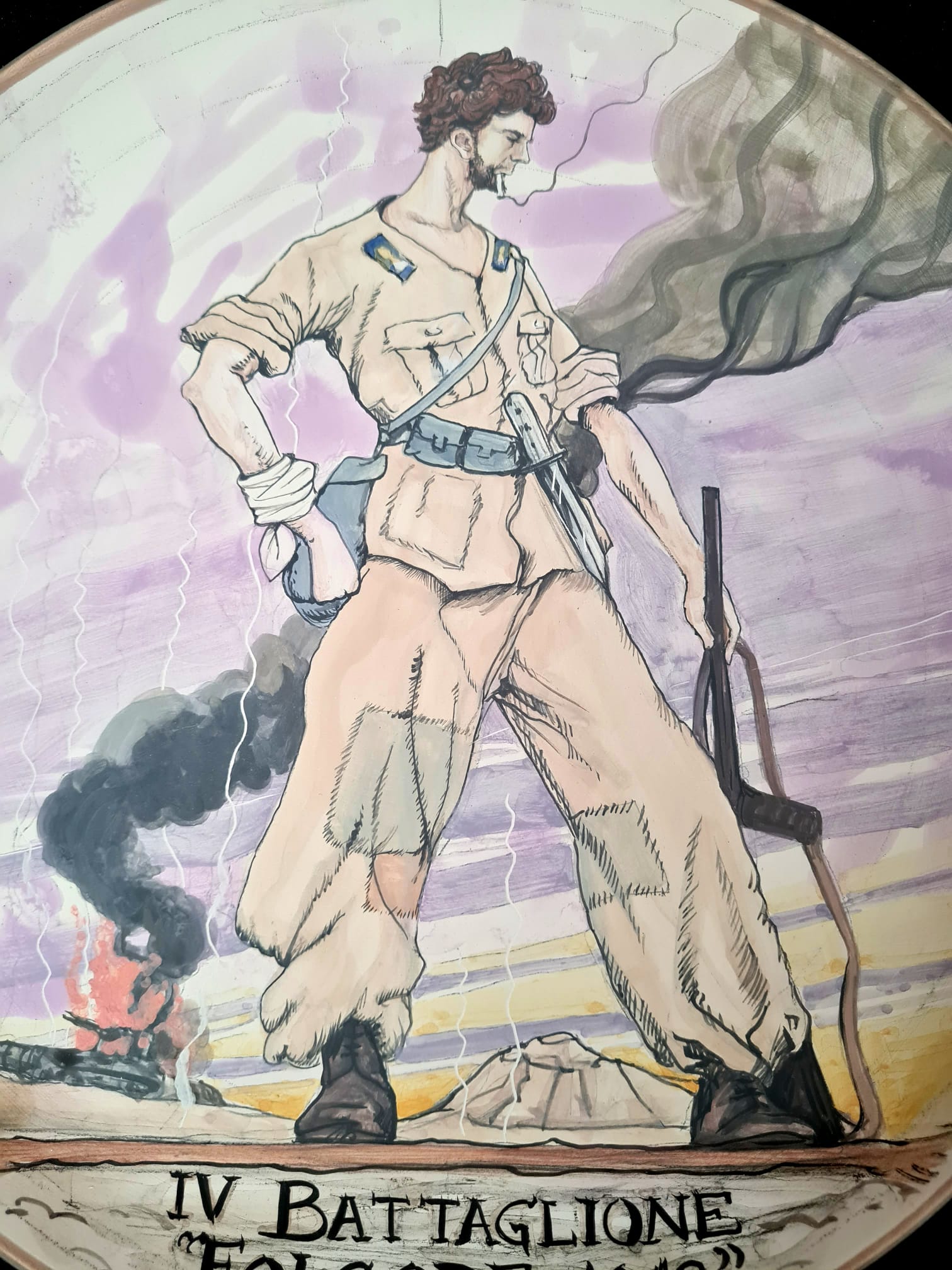
Throughout history, the military world has been represented mainly through celebratory art forms, intended to exalt courage, discipline and a sense of belonging. With contemporary art this narrative has been profoundly transformed: from glorification to critical reflection, from heroic storytelling to a more complex and often provocative inquiry.
Contemporary art no longer merely describes war or military institutions: it questions them. Artists explore trauma, memory, identity and power, offering points of view that often escape the official narrative. Installations, photographs, performances and video art tell not only what happens on the battlefield, but also the psychological and social consequences of conflict.
Filtered through contemporary art, the military world loses its rigidity and becomes a human story, fragile and complex: no longer just heroism and discipline, but memory, invisible wounds and unanswered questions.
Roots in the twentieth century
This change of perspective has deep roots. After the First World War, Otto Dix, who had fought at the front, published in 1924 the cycle of etchings Der Krieg (The War): fifty plates showing trenches, bodies and devastation without any rhetoric. A few years later, in 1937, Picasso’s Guernica would carry the same message before the whole world.
Contemporary artists take up this legacy, but with new tools and a different question: not only “what happened?”, but also “what remains, in those who were there and in those who came after?”.
The human side of the soldier
Far from the stereotyped image of the hero, many contemporary artists choose to portray the soldier’s vulnerability, loneliness and disorientation. The serviceman thus becomes a complex figure, set within a wider system of political decisions, economic dynamics and cultural tensions.
Photographer Tim Hetherington is an example. After following an American platoon in Afghanistan for months and making the documentary Restrepo (2010) with Sebastian Junger, he created Sleeping Soldiers, a video installation showing the faces of sleeping soldiers. Far from the action, they appear young, tired, defenceless: it is the most intimate portrait imaginable of those who live through war.
Collective memory and monuments
Contemporary art also addresses the theme of collective memory. Monuments and public works are no longer merely celebratory symbols but spaces for reflection. Some artists deconstruct traditional war memorials and invite the viewer to ask what is remembered and what, instead, is forgotten.
A famous example is the Vietnam Veterans Memorial in Washington, designed by Maya Lin: a wall of black granite engraved with the names of the fallen, inviting contemplation rather than celebration. Art thus becomes a means of reworking the past and building a critical awareness.
In Italy the contrast is clear if one compares a memorial like the one in Washington with the Redipuglia War Memorial, inaugurated in 1938: a monumental stairway holding the remains of some one hundred thousand soldiers who fell in the Great War, topped by the word “Presente” (“Present”) repeated on every step. Two different ways of remembering, both full of meaning, which also tell of the era in which they were born.
New languages, new experiences
Another central element is the use of new media. Digital technologies, virtual reality and artificial intelligence make it possible to create immersive experiences that bring the public closer to the reality of conflict in a direct and engaging way. These works not only inform but stimulate empathy and awareness, making the viewer an active part of the artistic process.
The German artist Harun Farocki, in the series Serious Games (2009–2010), showed the computer simulations used by the US Army both to train soldiers before deployment and to help them, on their return, to process trauma. The same tool serves to prepare for war and to heal its wounds: a short circuit that the work places before the viewer’s eyes.
Uniforms, symbols and rituals reinterpreted
Finally, there is a reflection on military language and aesthetics. Uniforms, symbols, hierarchies and rituals are reinterpreted and often deconstructed: contemporary art reworks them and places them in new contexts, turning them into instruments of critique or metaphors for today’s society.
Camouflage is an emblematic case. During the First World War the British painter Norman Wilkinson devised dazzle camouflage, geometric patterns painted on ships to confuse the enemy, close to the artistic avant-gardes of the time. Decades later, in 1986, Andy Warhol devoted his Camouflage series to it, turning it into pure pop imagery. A sign born to hide thus becomes something to look at.
And the figurative tradition?
Alongside this research, a figurative art that looks at tradition with today’s eyes lives on. Painting, ceramics and gold leaf can still tell the story of the military world, not to celebrate it uncritically, but to preserve its symbols, faces and stories. This too is a contemporary way of keeping memory alive: choosing what to preserve and giving it back with care, through the work of the hands.
Conclusion
As told by contemporary art, the military world is no longer a monolith of unchanging values but an open field of interpretation. Art becomes a space for dialogue in which memory and critique, aesthetics and politics, individual experience and collective history coexist. The public is invited not only to observe, but to understand and to question the deeper meaning of war and its representations.
If you are interested in the dialogue between art and military tradition, discover the works in the Portfolio or also read How Art Makes Military Traditions Immortal.